Dark Nautical Seamless Digital Paper: A Complete Guide for Designers and Creators
In the vast ocean of digital design resources, few elements capture the imagination quite like nautical seamless digital paper. When combined with a dark, moody palette, these patterns evoke the mystery and majesty of the deep sea—perfect for projects that demand elegance, depth, and a touch of adventure. Whether you’re a seasoned graphic designer, a hobbyist scrapbooker, or a small business owner creating branded materials, understanding what this product offers and how to use it can elevate your work from ordinary to extraordinary.
This guide will walk you through everything you need to know about dark nautical seamless digital paper—what it is, why its specifications matter, and how you can apply it in real-world projects. By the end, you’ll be ready to dive into your next creative endeavor with confidence.
What Is Seamless Digital Paper?
At its core, seamless digital paper is a repeating pattern designed to tile without visibly obvious edges. When you place multiple copies side by side, they connect flawlessly, creating a continuous, unbroken design. This makes it ideal for filling large areas—whether that’s a website background, a fabric print, or a full-page scrapbook layout.
The term “digital paper” itself comes from the traditional scrapbooking world, where physical patterned paper was cut, glued, and layered. Today, digital versions offer limitless possibilities: you can scale them, recolor them, and use them across both screen and print media. A dark nautical theme adds a specific aesthetic: think deep navy blues, charcoal blacks, and touches of gold or white. Motifs often include anchors, compass roses, ships, waves, stars, and rope knots—all rendered in a cohesive, often vintage or art-inspired style.
How Seamlessness Works
Creating a seamless pattern requires careful alignment at the edges of the tile. Designers use tools like Adobe Photoshop or Illustrator to ensure that the left edge matches the right edge, and the top matches the bottom. The result is a repeating tile that, when tiled, appears as one continuous design. This is crucial for applications where repetition is unavoidable—otherwise, you would see ugly seams or “tile lines” that break the illusion.
The Allure of Dark Nautical Themes
Why choose a dark nautical pattern over, say, a bright beach theme? The dark nautical aesthetic appeals to a sense of depth, mystery, and timelessness. It draws inspiration from the night sky over the ocean, stormy seas, and antique maritime charts. The color palette—rich navy, deep teal, slate, and charcoal—provides a sophisticated backdrop that makes brighter elements pop.
Design elements like vintage compasses, rope borders, and ship silhouettes add character without overwhelming the viewer. This style works wonderfully for:
- Digital scrapbooking – Create dramatic pages for travel memory books, adventure layouts, or masculine-themed albums.
- Planner stickers and printables – Dark nautical papers make unique weekly spreads, habit trackers, and mood boards.
- Website backgrounds – A subtle repeating anchor pattern can give a brand website an understated maritime vibe.
- Social media graphics – Use as overlay backgrounds for quotes, promotions, or event announcements.
- Product packaging – Custom wrapping paper, labels, and box liners with a dark nautical feel stand out on shelves.
- Fabric design – Upload to print-on-demand services for custom tote bags, pillow covers, or face masks.
Key Specifications Explained: What You Get
When you purchase a set of dark nautical seamless digital paper, the product description often includes a list of technical specifications. Here’s what each one means and why it matters for your projects.
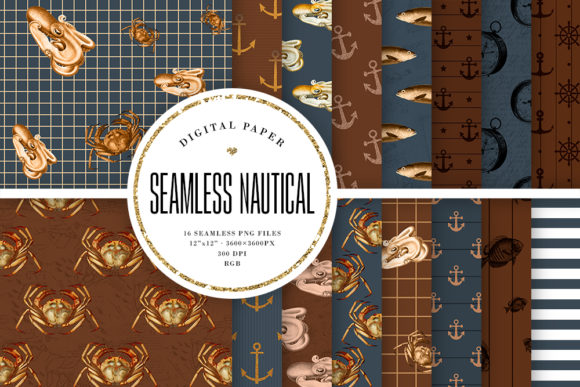
16 Seamless PNG Files
The set contains 16 unique patterns, each saved as a separate PNG file. PNG format supports transparency? (if the designer included it), but more importantly, it preserves crisp details and rich colors without compression artifacts. Having 16 different designs gives you variety—some might be all-over anchor patterns, others could feature subtle wave lines or star constellations. You can mix and match them across different projects or combine them in a single composition.
Pixel Dimensions 3600×3600
Each file is 3600 pixels wide by 3600 pixels tall. This is a large, high-resolution square image. Why 3600×3600? At 300 dots per inch (DPI), it translates to a 12×12-inch print. That’s a standard scrapbook page size and plenty large for many other uses. Even if you need a smaller size, you can always scale down without losing quality. Scaling up, however, is not recommended—this size gives you maximum flexibility for most print and digital applications.
Print Dimensions 12″x12″
As mentioned, each paper tile prints perfectly at 12 inches by 12 inches. This is the traditional size for 12×12 scrapbook albums. But you can also print them smaller: 6×6, 4×4, or even 2×2 inches by resizing in your design software. The seamless repeat means you can tile these prints to cover larger areas as well.
Color Mode RGB
RGB stands for Red, Green, Blue—the color model used for screens (monitors, phones, tablets). Files in RGB are ideal for digital use: websites, social media, digital planners, and online portfolios. If you plan to print them, you may want to convert to CMYK (Cyan, Magenta, Yellow, Black) for best results. However, many modern print services accept RGB files, and the conversion happens automatically. Being in RGB is not a problem; it just means the colors are optimized for screen vibrancy.
Resolution 300 DPI
300 DPI (dots per inch) is the standard printing resolution for high-quality output. At this DPI, the 3600-pixel file prints at 12×12 inches with crisp, sharp details. For web use, DPI doesnt matter (only pixel dimensions count), but having 300 DPI embedded in the file metadata ensures print services recognize it as high-resolution.
Practical Applications: Bringing Dark Nautical Patterns to Life
Now that you understand the specifications, let’s explore how you can use these seamless papers in real-world scenarios.
Digital Scrapbooking
Open your favorite digital scrapbooking software (like Photoshop, Affinity Photo, or Canva Pro). Import a dark nautical paper as the background layer. Use it as the base for photos, journaling blocks, and embellishments. Because the pattern is seamless, you can resize it to fit any page size without worrying about ugly seams if you tile it. Alternatively, use the paper as a fill for shapes—for example, an anchor-themed label with a matching pattern.
Planner and Journal Stickers
Design custom stickers for your ring-bound planner or bullet journal. Place the seamless paper behind transparent elements or use it as a full sticker sheet background. With 16 different designs, you can assign different patterns for different months or categories. A compass pattern for travel notes, a wave pattern for weekly check-ins, and a star chart pattern for goal pages.
Social Media and Web Graphics
Use these papers as backgrounds for Instagram posts, Facebook covers, or YouTube thumbnails. The dark tones provide excellent contrast for white or bright text. Simply drop the PNG into your graphic design tool, overlay your text, and export. Because they are seamless, you can easily extend the background to fit any aspect ratio (e.g., 1080×1080 for Instagram) by tiling or stretching.
Product Mockups and Packaging
Design your own product packaging for a small business. Wrap a box with paper printed at 12×12, or create custom tags and labels. The dark nautical patterns lend themselves well to handmade soaps, candles, or stationery with a maritime theme. Use the patterns as texture in mockup templates to showcase your designs.
Print-on-Demand Merchandise
Upload the seamless files to print-on-demand services (like Printful, Redbubble, or Society6) to create fabric items: pillows, tote bags, duvet covers, and even phone cases. The 3600×3600 pixel resolution and 300 DPI ensure that your patterns will print clearly and professionally.
How to Choose and Use Dark Nautical Seamless Papers Effectively
With 16 options, selecting the right pattern for a project can feel daunting. Here are a few tips to help you decide:
- Consider the mood: Some patterns are busy with many elements; others are subtle with just a few lines. Use busy patterns as accents only, and quieter patterns as larger background fills.
- Match your subject matter: For a layout about a beach vacation, choose a pattern with shells or stars. For a pirate-themed party invitation, go with crossed anchors or ship silhouettes.
- Scale matters: Don’t be afraid to scale the pattern up or down (in your design software) to change the density. A scaled-down pattern will repeat more frequently; a scaled-up pattern will show fewer elements but larger details.
- Combine with solid colors: Dark nautical papers pair beautifully with neutral solids like cream, white, gold, or soft gray. Use these to frame the patterned areas for a balanced composition.
Common Misunderstandings About Seamless Patterns
Even experienced designers sometimes misunderstand how seamless digital paper works. Let’s clear up a few common points:
“Seamless means you never see a repeat”
Actually, seamless refers to the edges, not the repeat itself. When tiled, the pattern will repeat, but the transition between tiles will be invisible. If you tile a 12×12 pattern across a 48×48-inch area, you will see the same anchor repeating every 12 inches—but there will be no line or break at the edges. That’s the seamless property.
“300 DPI is only for print, so I can ignore it for digital use”
While it’s true that DPI doesn’t affect screen display, having 300 DPI embedded is still useful: it tells print services the intended print size. For digital use, you can ignore DPI and work only with pixel dimensions.
“I can’t cut or crop a seamless pattern”
You absolutely can. If you crop a seamless pattern to a smaller area, you lose the seamless edge, but you can still use it as a standalone graphic. However, if you need it to tile again after cropping, you would need to re-tile the original full tile.
Conclusion
Dark nautical seamless digital paper is more than just a pretty set of patterns—it’s a versatile tool for countless creative projects. Understanding the specifications like 3600×3600 pixels, 300 DPI, and RGB color mode helps you use the files correctly, whether for screen or print. The moody, rich aesthetic of dark nautical themes adds sophistication and depth to scrapbooking, planner designs, branding, merchandise, and more.
By learning how to choose, scale, and combine these patterns, you open up a world of design possibilities. So next time you see a set of 16 seamless PNG files with those impressive spec numbers, you’ll know exactly how to put them to work. Dive in—your next masterpiece awaits.