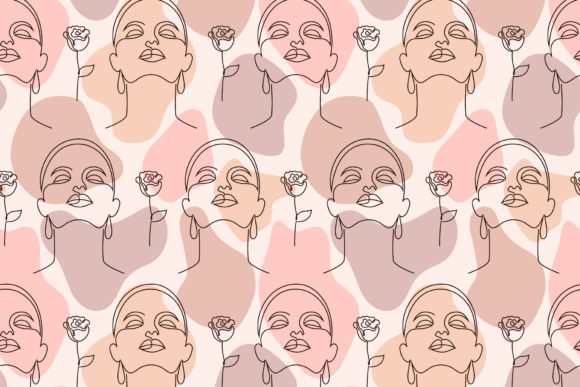
Dreaming Women and Roses
Some design resources feel like they belong in a specific box. You buy them for one project, use them once, and move on. But Dreaming Women and Roses is different. It is a seamless pattern set that combines scattered roses with faces of women placed over larger abstract shapes. The ZIP archive includes three files—EPS, SVG, and PNG—on a 2000 by 2000 pixel artboard. That means you can scale it, edit it, or drop it straight into your work without extra prep. What matters more is where this kind of visual actually fits into your daily life, your business, or your creative workflow.
Let us walk through real situations where this pattern solves a problem, adds atmosphere, or saves you time. No abstract theory, just practical scenarios that match how people actually use design assets.
Where Dreaming Women and Roses fits into real projects
The combination of floral elements and feminine faces is not new, but the way they are arranged on large background shapes gives this pattern a different feel. It is not just a repeating tile of roses and portraits. The shapes anchor the composition, so the pattern works equally well as a background element or as a focal point. That flexibility is what makes it useful across different formats and industries.
Branding and packaging for small businesses
If you run a small beauty brand, a candle company, or a boutique tea line, you are always looking for visuals that feel both elevated and approachable. Dreaming Women and Roses gives you a ready-made aesthetic that fits products aimed at women, self-care, or slow living. You can use the PNG file directly on product labels, hang tags, or wrapping paper. The 2000 x 2000 resolution means you are not stuck with pixelation when you print at moderate sizes.
For example, a small soap maker might place the pattern on the background of their website banner, then reuse the same tile on soap wrappers and Instagram posts. The consistency builds brand recognition without needing to hire a designer for every asset. The faces in the pattern add a human touch that plain floral repeats often miss.
Social media content and digital products
Bloggers, coaches, and digital creators constantly need backgrounds that do not look generic. A plain gradient or a stock photo of flowers can feel flat. Dreaming Women and Roses gives you a textured, layered look that works well for Instagram stories, Pinterest pins, YouTube thumbnails, or digital planners.
Consider a life coach who sells printable goal-setting journals. She can use the SVG file to place the pattern behind text blocks or section dividers inside the PDF. Because the file is vector, scaling it up or down does not reduce quality. That matters when your digital product might be viewed on phones, tablets, and laptops.
A blogger writing about slow fashion or sustainable beauty can use the PNG as a hero image background. The faces in the pattern subtly reinforce the human focus of the content, while the roses keep the mood soft and organic. Readers pick up on that visual coherence even if they do not articulate it.
When the format and resolution matter most
The ZIP archive includes EPS, SVG, and PNG. That might sound technical, but it translates into real choices depending on your project.
- EPS and SVG are vector formats. Use these when you need to resize the pattern without losing clarity. Great for large format prints, banners, or merchandise where the pattern needs to cover more surface area.
- PNG at 2000 x 2000 is a raster file with a transparent or solid background. Use this when you want to drop the pattern directly onto a design in Canva, Photoshop, or Keynote without extra steps. No need to ungroup or adjust paths.
If you are a print-on-demand seller, the vector files let you scale the pattern to fit t-shirts, totes, or phone cases without worrying about image degradation. The faces on big shapes become a statement design rather than a tiny detail lost at scale.
For educators or course creators who build slide decks, the PNG file works instantly. Paste it into a slide background, reduce opacity slightly, and layer your content on top. The pattern adds visual interest without distracting from your message.
Freelancers and designers
If you take on branding or social media clients, having a library of versatile patterns saves you ideation time. You can present Dreaming Women and Roses as a style option during mood board phases. The combination of organic roses and structured faces gives you a way to talk about balance between softness and strength in a brand identity. You can also modify the SVG in Illustrator to change colors or rearrange elements if the client wants a variation.
Event planners and invitation designers
Bridal showers, birthday parties, and intimate weddings often call for romantic visuals. The pattern works well on invitations, menu cards, or table numbers. Because the file is seamless, you can tile it across a full invitation suite without awkward seam lines. The faces add a contemporary edge that prevents the design from looking dated or overly traditional.
Educators and workshop facilitators
If you teach creative skills like journaling, art therapy, or design thinking, handouts and worksheets benefit from thoughtful backgrounds. A plain white page can feel sterile. A busy pattern can overwhelm. Dreaming Women and Roses strikes a middle ground. The large shapes keep the background calm, while the scattered roses and faces give the eye something pleasant to rest on.
Imagine a workshop on visual storytelling. Participants receive a worksheet with the pattern as a subtle background. The faces in the pattern spark conversation about representation, mood, and narrative in design. It becomes a teaching tool, not just decoration.
Marketers and content creators
Email newsletters, lead magnets, and e-books all benefit from cohesive visuals. A marketer building a free guide on self-care routines can use the pattern on the cover and inside section breaks. The seamless nature means it wraps around text blocks without looking chopped. The PNG file is easy to import into any layout tool, so the barrier to using it is low.
A Pinterest strategist might create a series of pins using the pattern as a consistent background element. The visual repetition across pins builds brand recognition. Users scrolling through a crowded feed pause on something that looks cohesive and intentionally designed.
What to consider before using Dreaming Women and Roses
Every design resource has its ideal context, and this pattern is no exception. Here are a few practical points to think about before you download and apply it.
Color compatibility. The pattern comes in a specific color palette. If your brand or project uses a very different set of colors, you may need to edit the vector files. The EPS and SVG formats allow recolor, but that requires vector editing software. If you only have access to basic image editors, the PNG version will work as-is. Check the preview images carefully to see if the tones align with what you need.
Scale and proportion. The 2000 x 2000 artboard is square. If your project uses a different aspect ratio, such as a vertical poster or a horizontal website header, you will need to crop or tile the pattern. Because it is seamless, tiling works well, but cropping means some elements near the edges may be cut off. Plan your layout with that in mind.
Balance with content. The pattern includes both faces and roses. That is visually rich, so it works best when paired with minimal typography or simple graphics. If you layer too much text or complex information on top of it, the design can feel busy. Use the pattern as an accent or background rather than a full-coverage texture behind heavy content.
Licensing and usage rights. Always check the license that comes with the ZIP archive. Some patterns allow commercial use, some restrict it to personal projects, and others require attribution. If you plan to sell products featuring the pattern, confirm that your intended use is covered. This step matters more for entrepreneurs than for hobbyists, but it is worth verifying regardless.
Connecting features to real outcomes
The value of Dreaming Women and Roses is not just in the file format or the resolution. It is in the time you save, the consistency you gain, and the emotional tone it brings to your work.
A hobbyist scrapbooking for a friend’s bridal shower uses the PNG file to print custom wrapping paper. The result looks curated, not last-minute. A small business owner uploads the SVG to a print-on-demand platform and launches a new product line in one afternoon instead of one week. A coach adds the pattern to a lead magnet and sees higher engagement because the visual quality signals professionalism.
These are not hypothetical wins. They are realistic outcomes when a pattern is versatile enough to move between print, digital, personal, and commercial contexts. The faces in the pattern add a layer of connection that plain florals cannot. People respond to faces, even in abstract form. That subtle psychological response works in your favor whether you are selling a product, teaching a concept, or telling a story.
Final thoughts on using this pattern in your workflow
If you are the kind of person who likes to have a few reliable visual assets ready to go, Dreaming Women and Roses deserves a spot in your folder. It covers the romantic, human-centered aesthetic that fits so many projects, yet it does not lock you into a single use case.
Open the EPS file if you work in Illustrator and want full control. Use the SVG if you need a scalable web graphic. Drop the PNG into your project when you want a quick, clean background that already looks complete.
The pattern works best when you treat it as a flexible layer rather than a fixed design. Recolor it, scale it, crop it, combine it with other elements. The seamless repeat means you are not stuck with obvious borders or awkward gaps.
Whether you are designing for yourself, for a client, or for an audience, this pattern gives you a head start on atmosphere and aesthetic. The faces and roses do the emotional work. The file formats handle the technical side. You get to focus on the message, the product, or the experience you want to create.