The Enduring Power of the Junglefowl Cockerel or Rooster in Retro Illustration
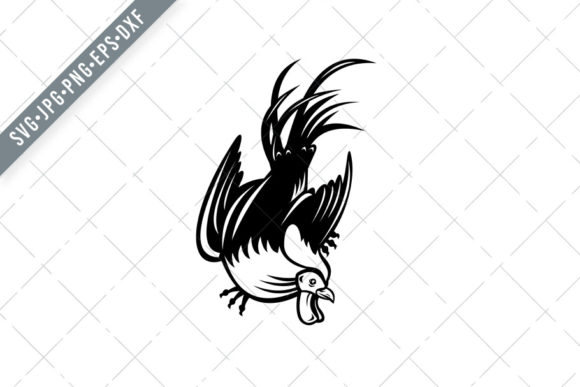
There is something primal about the stance of a junglefowl cockerel or rooster. It carries itself with an ancient defiance, a posture that has not softened over millennia of domestication. When rendered in a retro style illustration, especially in a fighting stance viewed from a low angle on an isolated black and white background, that image becomes more than just a bird. It becomes a symbol of resilience, a graphic statement that works across countless creative projects. Whether you are a seasoned designer, a hobbyist crafter, or someone exploring vector art for the first time, understanding how to use this kind of illustration effectively opens up a world of practical possibilities.
The junglefowl cockerel or rooster is the wild ancestor of every domestic chicken you have ever seen. Its natural aggression, sharp spurs, and upright comb make it a visually arresting subject. When an illustrator chooses a low angle view, the bird appears larger than life, looming with purpose. The fighting stance, with feathers ruffled and legs braced, conveys tension and energy. Strip away color and place it on an isolated background, and you are left with pure form. That is where retro style shines. It draws on mid-century linework, bold contrasts, and a sense of movement that feels both nostalgic and fresh. This combination is why such an image remains a favorite for everything from party invitations to wall art.
Why the Fighting Stance and Low Angle Matter
Composition is everything in graphic design. A junglefowl cockerel or rooster in a fighting stance does not just stand there passively. It engages the viewer. The low angle perspective exaggerates the chest, the beak points downward, and the tail feathers rise like a crest. This dynamic pose creates a natural focal point. On an isolated black and white background, there are no distractions. The eye follows the line of the neck, the curve of the wing, the tension in the legs. That clarity is what makes the illustration work across different formats.
Consider the psychology of the image. A fighting rooster suggests determination, courage, and a refusal to back down. Brands, event organizers, and individuals use this symbolism for sports teams, motivational posters, or even birthday themes for someone with a fiery personality. The retro style softens the aggression just enough. It is not hyper-realistic or gory. Instead, it feels like a graphic from a 1960s matchbook or a vintage brewery label. That nostalgic quality makes it approachable while still retaining the edge of the original subject.
Retro Black and White as a Design Choice
Black and white illustrations have a unique advantage. They reproduce well on nearly any surface or material. There is no worry about color matching, fading, or clashing with other elements. When you download a set that includes a SVG vector file for Silhouette Studio Cameo, Cricut, and other cutting machines, the black and white contrast ensures clean cuts. The same image, exported as a PNG file at 300dpi with a size of at least 10 inches or bigger, gives you plenty of resolution for print projects. You can scale it up for a large banner or shrink it down for a greeting card without losing detail.
The retro style itself relies on bold outlines and solid fills. This is not a delicate watercolor sketch. It is a graphic that demands attention. The isolated background means you can drop it onto any colored paper, fabric, or digital canvas. That flexibility is why designers keep coming back to this type of illustration. It works for a T-shirt just as well as it works for a stencil you might use on a reclaimed wood sign.
Practical Benefits of Multiple File Formats
One of the most common frustrations for crafters and designers is receiving a file that cannot be used with their preferred software or machine. That is why a well-prepared zip download includes multiple formats. Let me walk you through what each one offers and why it matters for your project.
- SVG vector file: This is the star of the show for cutting machines. SVGs store the image as mathematical paths, not pixels. You can resize them infinitely without any loss of quality. For Silhouette Cameo, Cricut, and similar machines, the SVG format preserves every detail of the fighting stance and low angle view. It also allows you to separate layers if you want to cut different parts in different colors.
- PNG file at 300dpi: If you need a raster image with a transparent background, this is your go-to. At 300dpi and at least 10 inches in size, it prints sharp and clear. You can use it for digital scrapbooking, party invitations, or uploading to print-on-demand platforms. The transparent background makes it easy to place the rooster over any other design element.
- DXF file: Some older or specialized cutting software prefers DXF over SVG. This is a common format in CAD and certain laser cutting applications. Having it in the set means you are covered no matter what system you use.
- EPS file: Professional vector editors like Adobe Illustrator and CorelDRAW handle EPS files natively. This format retains all the vector data and can be opened, edited, and re-saved without degradation. If you are a designer who likes to tweak curves or adjust line weights, the EPS file gives you that control.
- JPG file: Sometimes you just need a simple, universally viewable file. JPG works for quick previews, thumbnails, or sharing with clients who do not have specialized software. While it lacks a transparent background, it is still useful for reference or for projects where a white background is acceptable.
Having all five formats in one download saves you time and hassle. You do not need to convert files yourself, which can introduce errors or degrade quality. By purchasing a set that includes SVG, PNG, DXF, EPS, and JPG, you are essentially future-proofing your project. Whether you are making a single mug or a run of fifty T-shirts, you have the right file ready to go.
Creating T-Shirts, Mugs, and More
The practical applications for a junglefowl cockerel or rooster retro illustration are nearly endless. Let me give you some concrete examples based on real projects I have seen and worked on.
T-shirts: The fighting stance translates beautifully to apparel. A low angle view makes the bird fill the chest area of a shirt. Black ink on a white shirt is classic, but you can also use a colored shirt with a white heat transfer vinyl cut from the SVG file. The bold lines ensure the design reads well from across a room. For a retro look, pair it with a distressed font or a circular badge frame.
Mugs: A mug is a small canvas, so you need a design that makes an impact. The isolated background means you can wrap the rooster around the curve of the mug without awkward cropping. Sublimation printing works well with the PNG file, while a vinyl cut from the DXF or SVG works for a more permanent ceramic finish. This makes an excellent gift for someone who raises chickens, loves rooster decor, or just appreciates vintage graphic style.
Stencils: This is where the black and white, high-contrast nature of the illustration really shines. Cut the SVG file on a stencil blank using your Cricut or Silhouette, and you can spray paint or brush paint the design onto wood, canvas, fabric, or even furniture. The fighting stance with its clear negative space makes for a stencil that does not fall apart during use. You can create signs, wall art, or custom tote bags.
Wall art: Print the 300dpi PNG file at a large size, frame it, and you have instant vintage-inspired decor. Because the design is black and white, it fits into almost any color scheme. A series of these illustrations in matching frames along a hallway creates a cohesive gallery wall. You could also print on canvas or use the EPS file to have it professionally reproduced as a screen print.
Greeting cards and party invitations: The retro style immediately sets a tone. For a birthday invitation, the rooster in fighting stance can imply a "fight for your age" humor or simply a bold, fun aesthetic. Use the JPG or PNG file for a quick print-at-home card. For a more professional look, take the SVG or EPS file to a print shop and have them done on quality cardstock.
Practical Considerations for Your Workflow
Before you download and start creating, there are a few things to keep in mind that will save you frustration later. First, check the size of the PNG file. The listing says "at least 10 inches or bigger" at 300dpi. That means you can print it at 10 inches on the shortest side without interpolation artifacts. If you need it larger, use the SVG or EPS vector files. They scale infinitely.
Second, understand your machine's import capabilities. Most modern Cricut and Silhouette machines handle SVG files without issue. However, if you are using an older model or a different brand like Brother ScanNCut, the DXF file might be more reliable. Test a small cut first with inexpensive material before committing to an expensive piece of vinyl or fabric.
Third, consider the orientation. The low angle fighting stance usually works best when the bird is facing left or right across the canvas. For a T-shirt, center the design slightly above the middle of the shirt. For a mug, wrap it around so the beak leads the eye around the curve. For a banner, you might want a horizontal layout. Since the file is isolated, you can rotate and position it freely in your design software.
Scrapbooking, Patterns, and Beyond
The uses extend well beyond the obvious. In scrapbooking, a black and white junglefowl cockerel or rooster can anchor a page about farm life, heritage breeds, or even a trip to a rural area. The retro style keeps it from looking too modern or clinical. You can print it at a smaller scale using the PNG file and layer it with patterned paper and journaling cards.
For patterns, the SVG file can be tiled in vector software to create a seamless repeating pattern. Imagine a wallpaper or wrapping paper covered in these fighting stances, spaced evenly and rotated for variety. The black and white nature means you can print it onto fabric or use it as a digital pattern for mugs and notebooks. This is a powerful way to create a cohesive brand or product line.
Accessories: Think about keychains, patches, or pins. The thick lines of the retro style are ideal for laser-cut acrylic keychains. A pin badge with the rooster in fighting stance has a certain rebellious charm. You could also embroider the design if you convert the SVG to a stitch file, though that requires additional software. For iron-on patches, the PNG file printed on transfer paper works, or you can cut heat transfer vinyl from the SVG.
Birthday and event decor: A rooster theme might seem niche, but for a barnyard birthday, a rooster lover, or a "cock-a-doodle-doo" morning-themed brunch, this illustration is perfect. Create banners by cutting each letter and the rooster separately from the SVG file. Use the PNG file for cupcake toppers or party favor tags. The retro style adds a touch of sophistication that a cartoon chicken simply cannot match.
Why This Illustration Endures
There is a reason why the junglefowl cockerel or rooster has been a recurring motif in graphic design for decades. Its silhouette is instantly recognizable. The fighting stance communicates action. The low angle view commands respect. When you combine those elements with a retro black and white treatment, you get an image that works across generations and applications. It does not look dated in a bad way. Instead, it carries the weight of classic design principles. Good contrast, strong composition, and clear intent.
Whether you are making something for personal use or for sale, having a versatile set of files gives you the freedom to experiment. You might start with a T-shirt for yourself and end up creating a full line of products. The barriers are low because the file formats cover almost every tool you might own. The junglefowl cockerel or rooster is more than just a bird. It is a design asset that, once you have it in your library, will find its way into projects you have not even imagined yet. And that is the mark of a truly useful illustration.